Referral Tracker: attribution, stages and commission without partners seeing each other
A referral program creates two hard problems at once: proving which partner sent which inquiry, and making sure no partner can ever see another partner's data. Both are solved on the server, not in the interface.
Start an inquiryRelated service: White-label web development
- Evidence classWilde Digital internal project · working system, behaviour verified
- Built withNext.js, TypeScript, Prisma, PostgreSQL, Vitest
- InspectableThe build, the decisions and the tests are all on the record.
The situation
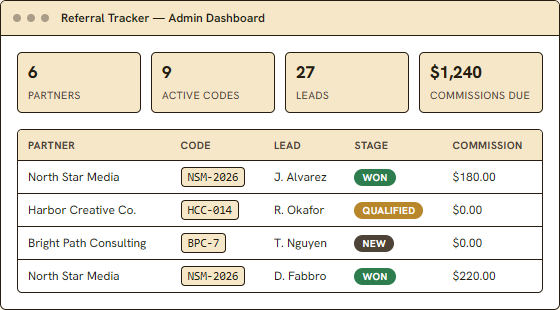
Referral arrangements usually run on trust plus a spreadsheet, which fails the moment two partners disagree about who introduced a client.
Partner-facing data means authorisation cannot be a matter of hiding a menu item — a request for someone else's record has to fail at the data layer.
What was built
- Coded referral links that attribute an inquiry to a partner at capture time.
- Lead stages from first contact through project and payment to commission state.
- Role-based access with server-side partner isolation: a partner's query can only ever return their own records.
- Commission calculation tied to recorded payments rather than manual entry.
- Automated authorisation and commission tests covering the isolation and the arithmetic.
Read the source
The repository is public, so the implementation and its tests can be inspected directly rather than taken on trust.
What this evidence covers
Evidence class: Wilde Digital internal project · working system, behaviour verified.
- Wilde Digital internal project. The observed result is technical: attribution, isolation and commission behavior verified by tests.
- No client adoption, partner volume or revenue outcome is claimed.
- The screenshot shows the system running with development data.
Why it is on this site
The operational half of inquiry follow-up: durable records, stages that mean something, and authorisation enforced where it cannot be bypassed.
The same capability, applied to this service. This particular project was not commissioned under it.
Discuss the work your project needs
Describe the situation in a couple of sentences. The reply will distinguish relevant implementation capability from work outside the current service scope.